
CASE NAME: Willis Albrigo v. Quten Research Institute, LLC
CASE NO.: 3:26-cv-03875-BAS-DEB
JURISDICTION: United States District Court, Southern District of California
FILED ON: July 6, 2026
CLASS DEFINITION: All persons in California who purchased Qunol Ultra Omega-3 Fish Oil for personal or household use during the applicable class period
SUMMARY:
According to the complaint, Quten Research Institute, LLC is accused of falsely advertising its Qunol Ultra Omega-3 Fish Oil supplements by claiming that each serving contains “1000 mg Omega-3” when independent testing allegedly shows significantly lower levels. The lawsuit alleges that consumers rely on omega-3 content as the primary measure of a fish oil supplement’s value and effectiveness, and that the alleged misrepresentation led consumers to pay a premium for a product that did not deliver the promised nutritional benefits.
ALLEGATIONS:
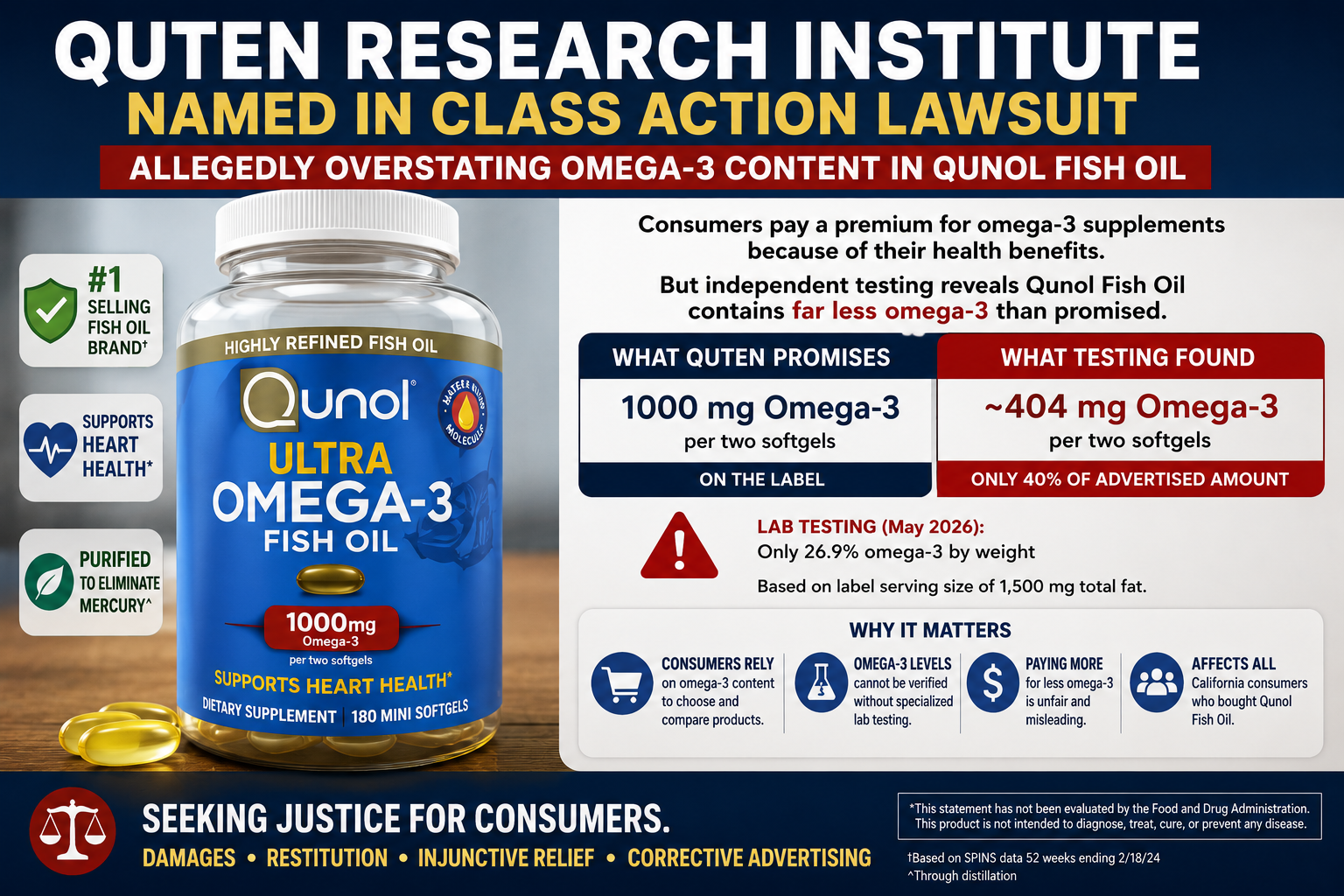
The lawsuit alleges that Quten engaged in deceptive labeling by prominently displaying “1000 mg Omega-3” on the front of its Qunol Fish Oil packaging, as shown in the product image included on page 2 of the complaint. This representation, according to the plaintiff, communicates to consumers that each serving—defined as two soft gel capsules—provides 1000 milligrams of omega-3 fatty acids.
However, the complaint contends that independent laboratory testing contradicts this claim. Testing conducted in May 2026 by an accredited laboratory reportedly found that the product contains only about 26.9% omega-3 fatty acids by weight. Based on the labeled serving size of 1,500 mg of total fat, this equates to approximately 404 mg of omega-3 per serving—less than half of the advertised 1000 mg.
The plaintiff alleges that this discrepancy is material because consumers purchase fish oil supplements specifically for their omega-3 content, particularly EPA and DHA, which are associated with health benefits such as heart health. As described in the complaint, consumers often compare products based on omega-3 levels, and those with higher advertised amounts typically command higher prices.
The lawsuit further alleges that Quten was aware of concerns regarding its omega-3 content claims prior to this action. According to the complaint, testing by Consumer Reports in 2024 also found that Qunol Fish Oil contained less omega-3 than advertised. Although Quten disputed those findings, the complaint states that the company failed to provide evidence supporting its explanation and continued using the same labeling claims.
Additionally, the complaint notes that Quten and its products have been subject to prior litigation involving similar allegations of overstated nutrient content. The plaintiff alleges that these prior issues put the company on notice that its labeling may be inaccurate, yet it continued to market the product with the same “1000 mg Omega-3” representation.
The plaintiff claims she purchased the product in March 2026 relying on the front-label representation and believed she was receiving 1000 mg of omega-3 per serving. According to the complaint, she would not have purchased the product—or would have paid less—had she known the true omega-3 content.
The lawsuit alleges that consumers cannot independently verify omega-3 content without specialized laboratory testing, making them particularly vulnerable to misleading labeling. As a result, the plaintiff claims that Quten’s conduct caused economic harm by inducing consumers to pay a price premium for a product that did not meet advertised specifications.
The complaint brings claims under California’s Unfair Competition Law, False Advertising Law, and Consumer Legal Remedies Act, as well as claims for negligent misrepresentation and unjust enrichment. The plaintiff seeks damages, restitution, injunctive relief, corrective advertising, and an order requiring the company to stop the alleged deceptive practices.

Leave a Reply