
Case Information
Case Name: Fetters v. Universal Protein Supplements Corporation d/b/a Universal Nutrition
Case No. 2:26-cv-09758
Jurisdiction: United States District Court for the Central District of California
File Date: 09/01/26
Class Definition: All U.S. citizens who purchased Animal 5g Creatine Chews from Amazon.com in their state of citizenship for personal and household use within the applicable statute of limitations, including a California subclass of California citizens who made such purchases while in California.
Summary
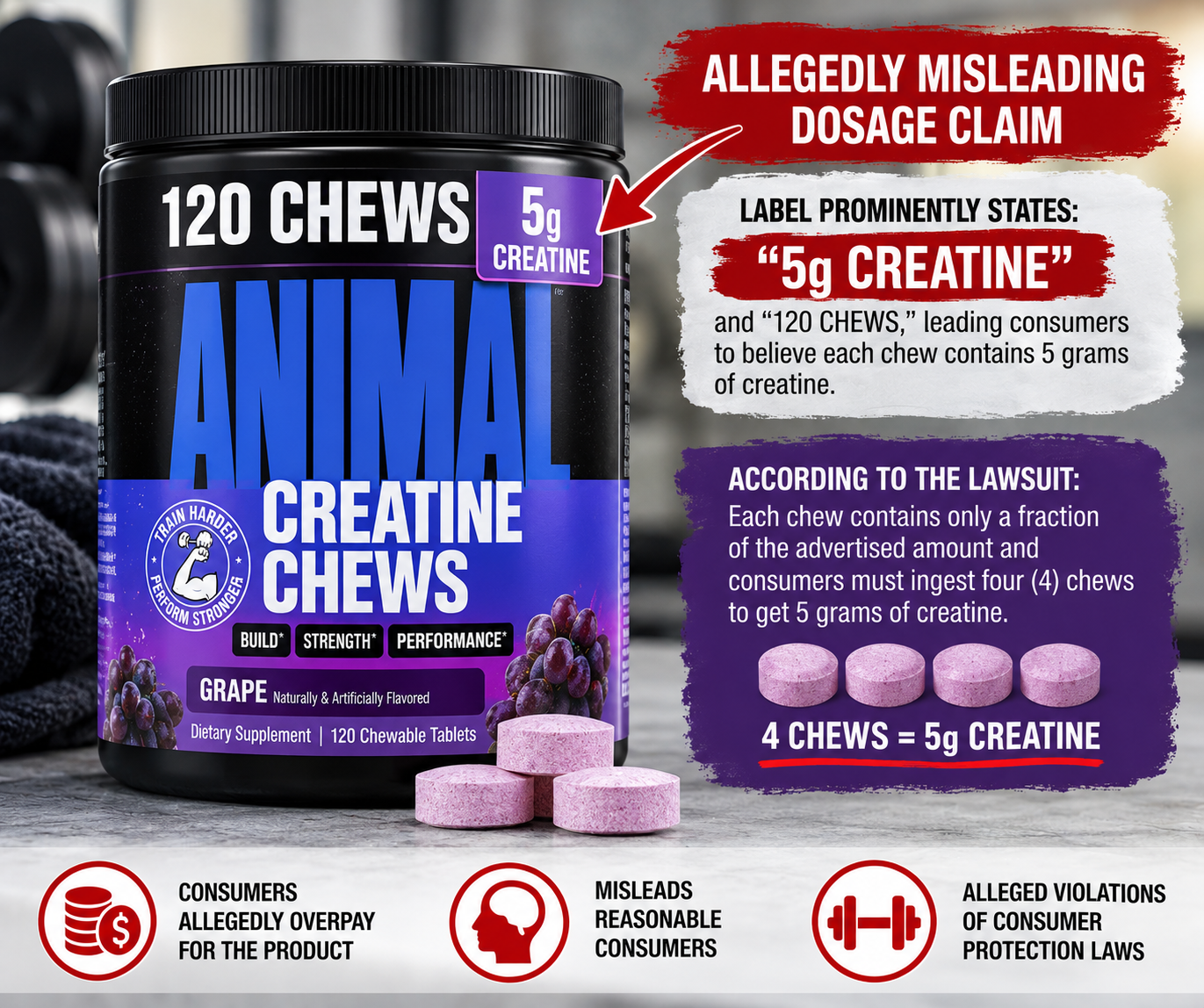
According to the complaint, plaintiff Dean Fetters brings a proposed nationwide class action against Universal Protein Supplements Corporation, doing business as Universal Nutrition, alleging that the company misleads consumers about the creatine content of its Animal 5g Creatine Chews sold on Amazon.com. The lawsuit claims the front label’s prominent “5g creatine” statement, paired with the total chew count, conveys that each chewable tablet contains 5 grams of creatine, when the supplement facts allegedly reveal that four chews are required to obtain that amount. As a result, the complaint asserts that consumers receive only a fraction of the advertised creatine per chew while paying a price premium. The suit seeks damages, restitution, injunctive relief, and other remedies on behalf of purchasers nationwide and in California.
Allegations
The lawsuit alleges that Universal Nutrition manufactures and markets Animal 5g Creatine Chews, a dietary supplement sold in flavors such as:
- Grape
- Fruit Punch
- Lemon Ice
- Candy Crush’d
- Smarties
through Amazon.com. According to the complaint, the product’s front label prominently displays the phrase “5g creatine” alongside the total number of chewable tablets in each container, for example “120 chewable tablets.” The plaintiff contends that this presentation leads reasonable consumers to believe that each individual chew delivers 5 grams of creatine.
The complaint further alleges that the supplement facts panel tells a different story. According to the lawsuit, the panel states that a serving size is four chewable tablets and that each serving, not each chew, contains 5 grams of creatine monohydrate. Based on this disclosure, the plaintiff claims that each chew tablet actually contains only one quarter of the represented amount of creatine. The complaint asserts that this discrepancy between the front label and the serving-size information renders the product’s labeling false, misleading, and deceptive to ordinary consumers.
The lawsuit compares Universal Nutrition’s labeling practices to those of competing products. According to the complaint, competitors such as Momentous Creatine Chews label their products to specify the amount of creatine “per chew,” while Bloom Nutrition 5g Creatine Gummies disclose that 5 grams of creatine are provided “per serving” of three gummies. The complaint alleges that, unlike these competitors, Universal Nutrition omits any qualifying language such as “per serving” on the front label of Animal 5g Creatine Chews, despite using a serving size of four chews to reach the advertised 5 grams of creatine. The plaintiff claims this omission gives Universal Nutrition an unfair competitive advantage by making its product appear more potent or cost-effective than it actually is.
Plaintiff Dean Fetters, a California citizen, alleges that he purchased the Grape flavor Animal 5g Creatine Chews on Amazon.com while in Los Angeles during the class period. He claims he saw and relied on the “5g creatine” statement and the total tablet count on the front label, and that he reasonably understood those representations to mean that each chew tablet contained 5 grams of creatine. According to the complaint, Fetters would not have purchased the product, or would have paid less for it, had he known that four chews were required to obtain the advertised 5 grams of creatine. He alleges that he paid a price premium based on the challenged labeling, that the product was worth less than the amount he paid, and that he lost money as a result. The complaint also states that Fetters would consider purchasing the product again in the future if the labeling were corrected to accurately reflect the creatine dosage per chew or per serving.
The proposed nationwide class includes all U.S. citizens who purchased Animal 5g Creatine Chews from Amazon.com in their state of citizenship for personal and household use within the applicable statute of limitations up to the date of class notice. A California subclass is defined for California citizens who made similar purchases while in California. The complaint asserts that common issues predominate over individual ones, including whether the “5g creatine” representation is likely to mislead reasonable consumers, whether purchasers paid a price premium due to the alleged mislabeling, and the appropriate measure of restitution, damages, and injunctive relief.
Legally, the complaint asserts claims under California’s:
- Unfair Competition Law
- False Advertising Law
- Consumer Legal Remedies Act
It also alleges:
- Breach of express warranty
- Breach of implied warranty
- Negligent misrepresentation
- Intentional misrepresentation or fraud
- Quasi-contract or unjust enrichment
According to the lawsuit, Universal Nutrition’s conduct is “unlawful,” “unfair,” and “fraudulent” because it allegedly misrepresents the creatine dosage per chew, obscures the true amount delivered per tablet, and induces consumers to pay more than the product is actually worth. The complaint seeks public injunctive relief to stop the allegedly misleading practices, corrective advertising, restitution of the purported price premium, disgorgement of profits, compensatory and, where permitted, punitive damages, as well as attorneys’ fees and costs on behalf of the proposed classes.

Leave a Reply