Case Details
- Case Name: Maria Chiaravalloti v. The Procter & Gamble Company
- Case No.: 26-cv-6902
- Jurisdiction: United States District Court Southern District of New York
- Filed on: 08/12/26
- Class Definition: All people in the state of New York who purchased Native Unscented Deodorant for personal or household use during the last four years.
Summary
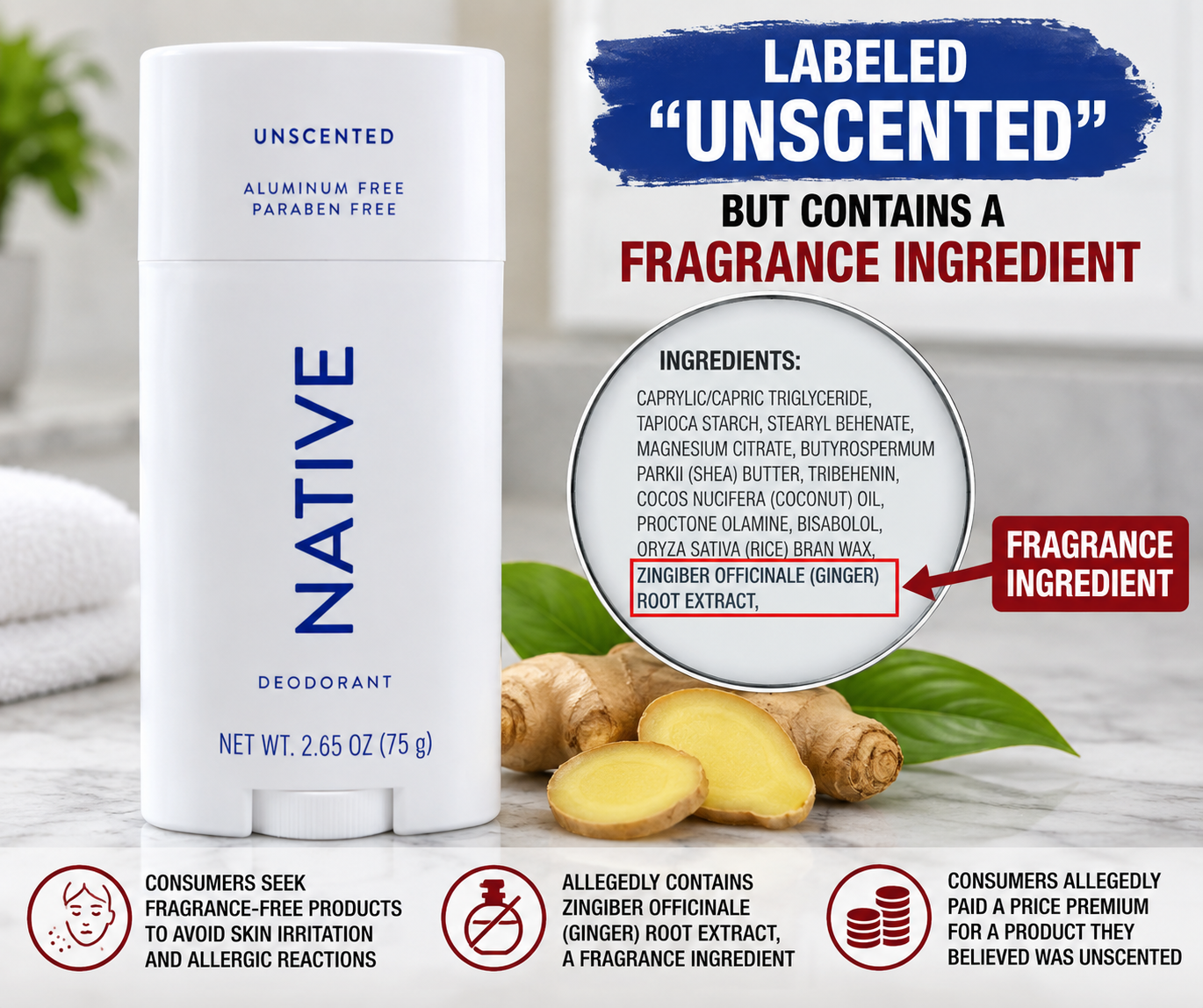
The complaint alleges that The Procter & Gamble Company falsely markets its Native Unscented Deodorant as “unscented” despite listing Zingiber officinale (ginger) root extract, which the suit describes as a fragrance ingredient that can impart scent and potentially cause skin sensitivity. The plaintiff asserts that reasonable consumers understand “unscented” to mean no fragrance ingredients have been added, and that Procter & Gamble leveraged demand for fragrance-free products by charging a higher price for the unscented version.
The plaintiff claims consumers—particularly those with skin sensitivities, allergies, or a desire to avoid fragrances—were misled by the “unscented” labeling and paid a price premium they would not have paid had they known the product contained a fragrance ingredient. On behalf of a New York class, the complaint brings claims under New York General Business Law §§ 349 and 350 for deceptive business practices and false advertising, and seeks damages, disgorgement, and injunctive relief.
Allegations
The complaint alleges Procter & Gamble manufactures, markets, and sells Native Unscented Deodorant in thousands of retail locations across the United States, including numerous outlets in New York, and prominently labels the product “unscented” on the front of the package. According to the suit, this “Unscented Representation” communicates to reasonable consumers that the deodorant does not contain fragrance ingredients and is suitable for those avoiding fragrances for health, personal, or environmental reasons.
The complaint states demand for “unscented” products has grown as consumers seek to avoid fragrance ingredients that may trigger skin irritation, allergic reactions, or conflict with fragrance-free policies. It alleges companies have introduced and promoted unscented versions and that consumers are willing to pay a price premium for such items based on the belief they contain no added fragrance ingredients.
Despite the “unscented” marketing, the complaint contends the ingredient list discloses Zingiber officinale (ginger) root extract. The lawsuit describes this ingredient as an aromatic essential oil that imparts a warm, spicy, and fresh scent and alleges ginger root extract contains compounds (e.g., gingerol and shogaol) that can cause contact dermatitis and skin sensitivity in some individuals. Because ginger root extract is alleged to be a fragrance ingredient, the plaintiff maintains the deodorant is not truly “unscented,” and that the front-label representation is false and misleading.
The complaint asserts nothing on the front of the product qualifies or limits the “unscented” claim to indicate the deodorant may still contain aromatic botanical extracts. The word “unscented” is allegedly presented without clarification, leading consumers to believe the product contains no fragrance ingredients. The suit alleges the fine-print ingredient list on the back or side of the packaging does not cure this alleged deception because reasonable consumers are not expected to resolve conflicts between prominent front-label claims and technical ingredient disclosures. It further alleges average consumers are unlikely to recognize that “Zingiber officinale (ginger) root extract” functions as a fragrance ingredient.
The complaint alleges Procter & Gamble charges more per ounce for Native Unscented Deodorant than for at least one scented version of the same product line. The plaintiff cites this alleged price difference as evidence the “unscented” representation commands a price premium and claims she and other class members paid more than they otherwise would have due to the challenged labeling.
On behalf of a proposed class of all New York consumers who purchased Native Unscented Deodorant for personal or household use within the last four years, the plaintiff alleges purchasers were uniformly exposed to the same “unscented” label and suffered economic injury by paying a price premium for a product that allegedly contained a fragrance ingredient. The lawsuit asserts this conduct constitutes deceptive acts and practices in violation of New York General Business Law § 349 and false advertising in violation of § 350 because the “unscented” statement is materially misleading and likely to deceive reasonable consumers.
Leave a Reply