
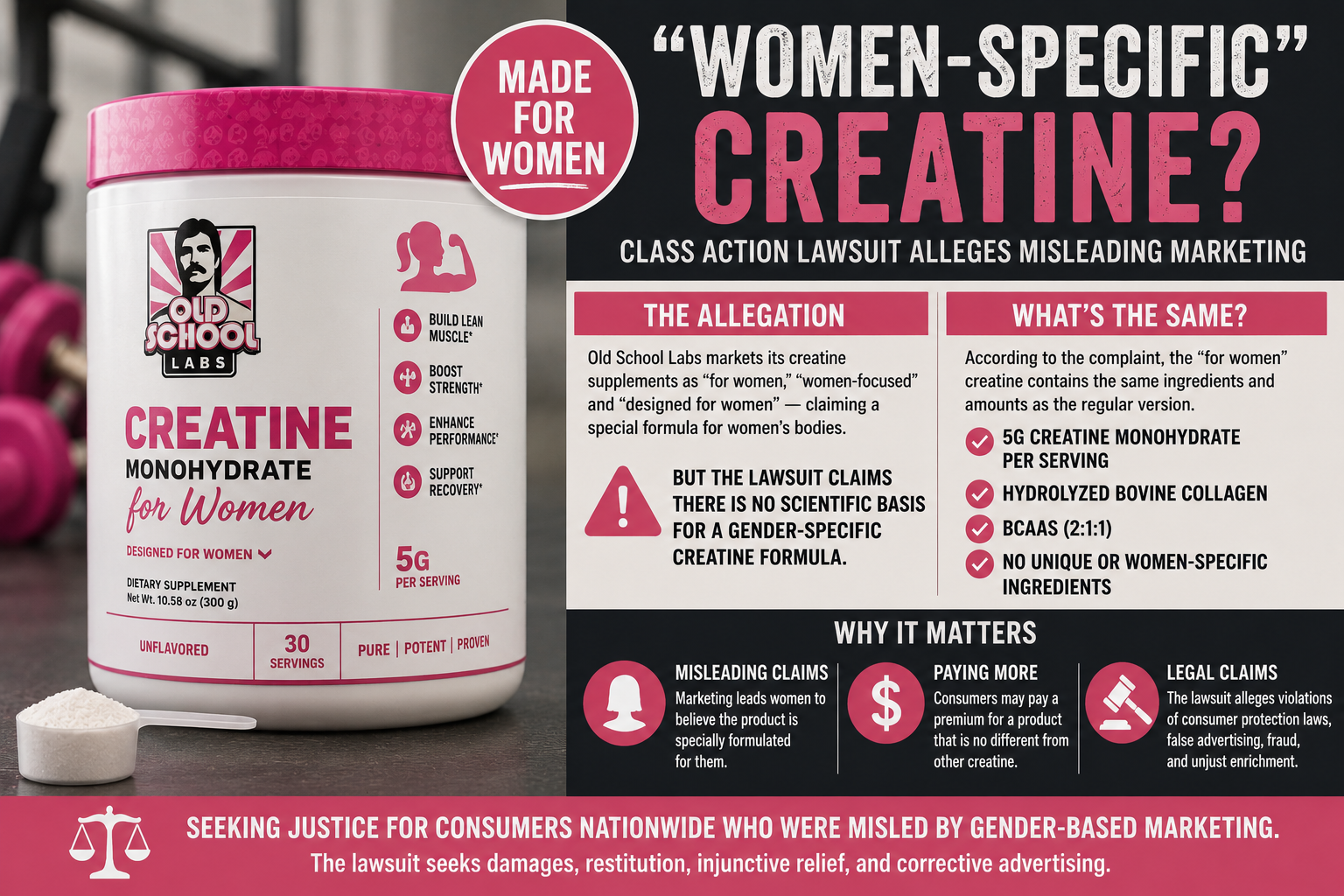
CASE NAME: Orozco v. Cosidla, Inc. d/b/a Old School Labs
CASE NO.: 2:26-cv-07820
JURISDICTION: United States District Court, Central District of California
FILED ON: July 16, 2026
CLASS DEFINITION: All consumers nationwide, including in California and Illinois, who purchased Old School Labs creatine products marketed specifically “for women” during the applicable class period
SUMMARY:
Old School Labs is accused of deceptively marketing certain creatine supplements as specifically designed for women despite allegedly containing the same ingredients and formulations as gender-neutral products. The lawsuit claims that the company used gender-based branding, packaging, and advertising to create the false impression that the products offered unique benefits for women. Plaintiffs allege that consumers relied on these representations and were misled into purchasing products that were not meaningfully different from standard creatine supplements.
ALLEGATIONS:
The lawsuit alleges that Old School Labs engaged in a deliberate marketing strategy targeting female consumers by labeling certain creatine products as “for women,” “women-centric,” and “designed for women.” According to the complaint, these claims appeared across product packaging, online listings, and promotional materials and were reinforced through design elements such as pink and white color schemes and messaging focused on women’s fitness goals.
Plaintiffs contend that these representations are misleading because there is no scientific basis for a gender-specific creatine formulation. As described in the complaint, creatine is a well-studied compound used to support muscle energy and performance, and it functions the same regardless of gender. The lawsuit alleges that no variation of creatine exists that can be uniquely formulated for women.
The complaint further alleges that the ingredients in the “women’s” creatine products are materially identical to those in Old School Labs’ standard, non-gendered creatine products. For example, both versions allegedly contain the same amount of creatine monohydrate—5 grams per serving—despite being presented differently (e.g., “5g” versus “5,000 mg”) to suggest a distinction.
In addition to creatine, the products include ingredients such as hydrolyzed bovine collagen and branched-chain amino acids (BCAAs). According to the complaint, these ingredients are also not gender-specific and are widely used in general supplements for all consumers. The lawsuit asserts that none of these components, individually or in combination, provide unique benefits tailored specifically to women.
The plaintiff alleges that Old School Labs’ marketing creates a false impression that the products are specially engineered for women’s bodies and fitness needs. As shown in product imagery referenced in the complaint (e.g., page 4), the packaging prominently emphasizes female-focused branding and messaging such as “booty-building” and “made for women,” which allegedly reinforce this perception.
According to the complaint, this strategy exploits consumer demand for personalized and gender-specific health products. Plaintiffs allege that women are led to believe they need a distinct supplement tailored to their physiology, when in reality the products are functionally identical to gender-neutral alternatives.
The lawsuit also claims that Old School Labs used comparative marketing to further the alleged deception. For instance, the company allegedly promoted its products as having a “women-concentrated formula” that competing brands lack, suggesting a unique formulation that does not exist.
The plaintiff states that she purchased the product believing it was specifically designed for women and would provide targeted benefits such as reduced bloating and improved physique outcomes. According to the complaint, she would not have purchased the product—or would have chosen a less expensive alternative—had she known the truth about its formulation.
The lawsuit further alleges that this conduct constitutes a broader pattern of gender-based marketing that artificially differentiates products without meaningful differences. Plaintiffs claim this practice misleads consumers, limits informed purchasing decisions, and results in economic harm.
The complaint brings claims under multiple consumer protection statutes, including California’s Consumer Legal Remedies Act, False Advertising Law, and Unfair Competition Law, as well as the Illinois Consumer Fraud Act and common law claims such as fraud and unjust enrichment. Plaintiffs seek damages, restitution, injunctive relief, and corrective marketing practices.



Leave a Reply