CASE INFORMATION
Case Name: Mark Glickman v. Church & Dwight Co., Inc.
Case No. 2:26-cv-04936
Jurisdiction: United States District Court Eastern District of New York
Filed on: 08/12/26
Class Definition: All persons in New York who purchased Arm & Hammer Essentials Unscented Deodorant or Arm & Hammer UltraMax Unscented Antiperspirant and Deodorant for personal or household use within the last four years.
SUMMARY
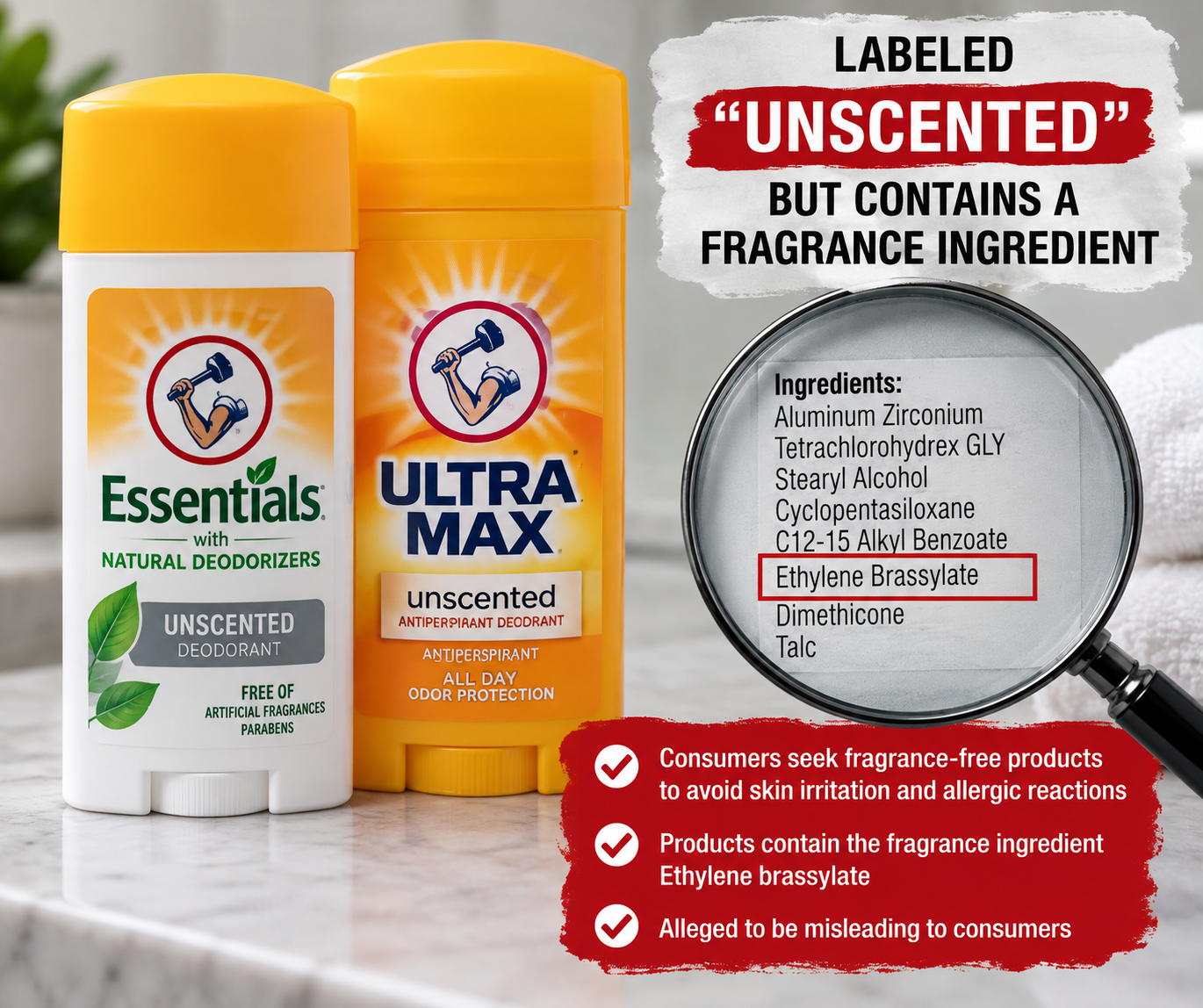
According to the complaint, plaintiff Mark Glickman has filed a putative consumer class action against Church & Dwight Co., Inc., the manufacturer of Arm & Hammer-branded personal care products, alleging that two deodorant products marketed as “unscented” actually contain a synthetic fragrance ingredient called ethylene brassylate. The lawsuit contends that the “unscented” and related “No Artificial Fragrance” representations are false and misleading because consumers allegedly understand such claims to mean the products contain no added fragrance ingredients.
The complaint further alleges that consumers paid a price premium or purchased the products they otherwise would not have purchased in reliance on these representations, and that Church & Dwight’s conduct violates New York consumer protection laws. The plaintiff seeks to certify a New York class, obtain monetary damages, restitution, and injunctive relief, and pursue claims under New York General Business Law sections 349 and 350 for deceptive acts and false advertising.
ALLEGATIONS
The complaint alleges that Church & Dwight Co., Inc. manufactures and sells Arm & Hammer Essentials Unscented Deodorant and Arm & Hammer UltraMax Unscented Antiperspirant and Deodorant throughout the United States, including in New York. According to the lawsuit, both products are prominently labeled as “unscented,” and the Essentials product additionally contains the statement “No Artificial Fragrance” on its packaging. The plaintiff contends that these statements are designed to, and do, communicate to reasonable consumers that the products do not contain fragrance ingredients.
The lawsuit asserts that there is growing consumer demand for products that are unscented or free of artificial fragrances. According to the complaint, many consumers seek unscented personal care items due to concerns about skin irritation, allergies, and sensitivities, as well as workplace rules that limit or discourage the use of scented products. The complaint also alleges that some consumers prefer products with fewer additives and perceive “unscented” or “no artificial fragrance” claims as signals of a simpler or gentler formulation. As a result, the plaintiff claims that consumers are willing to pay more for products they believe do not contain added fragrances, creating a price premium for such items.
Contrary to these alleged consumer expectations, the complaint states that both challenged Arm & Hammer products contain ethylene brassylate, which the plaintiff describes as a synthetic musk with a sweet, floral scent that is commonly used as a fragrance ingredient in consumer goods. The lawsuit alleges that ethylene brassylate appears on the products’ ingredient lists, and that its presence means the deodorants are not truly “unscented.” Because of this ingredient, the plaintiff contends that the “unscented” and “No Artificial Fragrance” representations on the front labels are false, misleading, and deceptive.
The complaint further alleges that the front labels of the products do not include any disclaimer, asterisk, or qualifying language to indicate that the products nevertheless contain a fragrance ingredient. According to the lawsuit, reasonable consumers understand “unscented” to mean that a product does not contain added fragrance ingredients, not merely that it has no strong or noticeable scent. The plaintiff asserts that consumers are not expected to parse back-panel ingredient lists to correct an allegedly misleading message on the front label, and that most people would not recognize “ethylene brassylate” as a fragrance even if they read the ingredient statement.
The complaint claims that Church & Dwight knew or should have known that consumers would rely on the “unscented” and “No Artificial Fragrance” representations when choosing between competing deodorant products. The lawsuit alleges that these front-label statements were material to purchasing decisions and that the company understood they would influence consumers who are specifically seeking products without added fragrances. According to the plaintiff, Church & Dwight nonetheless continued to market and sell the products with these representations while including ethylene brassylate in the formulations.
On behalf of a putative class of all New York purchasers of the two products for personal or household use within the last four years, the plaintiff alleges that each class member was exposed to the same or substantially similar “unscented” labeling. The complaint contends that class members suffered economic injury because they paid more for the products than they otherwise would have, or they would not have purchased the products at all had they known the truth about the inclusion of ethylene brassylate. The lawsuit asserts that common questions predominate, including whether the “unscented” representation is truthful, whether Church & Dwight’s conduct is deceptive or misleading to reasonable consumers, and whether the company was unjustly enriched through its marketing and sale of the products.
The complaint brings causes of action under New York General Business Law sections 349 and 350, alleging that Church & Dwight engaged in deceptive business practices and false advertising. The lawsuit seeks the following relief:
- Class certification
- Monetary damages, including actual, statutory, and punitive damages
- Restitution or disgorgement of alleged ill-gotten gains
- Injunctive relief to stop the challenged labeling practices
- Prejudgment interest
- An award of attorneys’ fees and costs
- A jury trial on all issues so triable
Leave a Reply