CASE NAME: Turner v. Costco Wholesale Corporation
CASE NO.: 8:26-cv-01013
JURISDICTION: United States District Court for the Central District of California
FILED ON: April 29, 2026
CLASS DEFINITION: All persons in the United States who purchased Kirkland Signature Five Cheese Tortelloni with Parmigiano Reggiano during the applicable statute of limitations, including multi-state subclasses and a California subclass.
SUMMARY:
According to the complaint, Costco Wholesale Corporation is facing a class action lawsuit alleging that it falsely markets its Kirkland Signature Five Cheese Tortelloni as containing “no preservatives.” Plaintiffs claim that this representation is misleading because the product allegedly contains manufactured citric acid, which functions as a preservative. The lawsuit contends that consumers were deceived into believing the product was free from artificial preservatives and paid a premium as a result.
ALLEGATIONS:
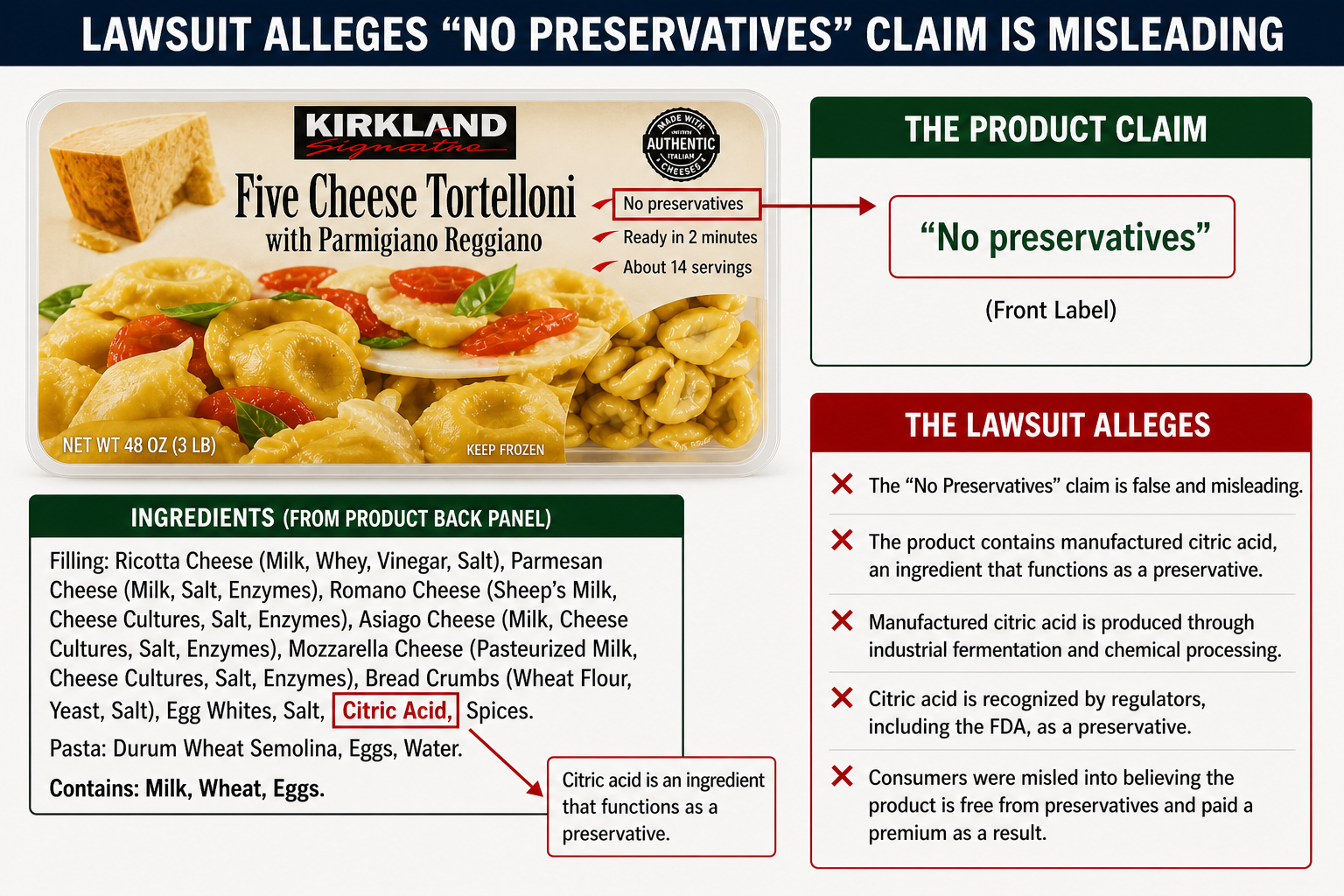
The lawsuit alleges that Costco markets its Kirkland Signature Five Cheese Tortelloni with a prominent “no preservatives” claim on the front label. As shown in the product image on page 5 of the complaint, this statement is displayed clearly on the packaging, leading consumers to believe the product does not contain any artificial preservatives.
According to the complaint, this representation is false and misleading because the ingredient list on the back panel discloses the presence of manufactured citric acid. Plaintiffs allege that this ingredient functions as a preservative and therefore contradicts the “no preservatives” claim.
The complaint explains that manufactured citric acid differs from naturally occurring citric acid found in fruits. It is allegedly produced through industrial fermentation processes involving the mold Aspergillus niger, often using genetically modified inputs and chemical solvents. The lawsuit cites scientific and regulatory sources indicating that this form of citric acid is synthetic and widely used as a food additive. As described in the scientific discussion on pages 6 through 8, the manufacturing process involves fermentation and chemical extraction, distinguishing it from naturally derived ingredients.
Plaintiffs further allege that citric acid is recognized by regulators as a preservative. The complaint references FDA guidance and regulatory materials indicating that citric acid can function to prevent spoilage and extend shelf life. On page 12, the complaint notes that the FDA defines preservatives as chemicals that retard food deterioration and includes citric acid among commonly used preservatives.
The lawsuit also alleges that Costco’s labeling creates a misleading impression about the product’s quality and composition. Plaintiffs claim that reasonable consumers interpret “no preservatives” to mean the absence of artificial or synthetic preservation agents. By including manufactured citric acid while making this claim, the complaint alleges that Costco misrepresents the nature of the product.
The named plaintiff states that she purchased the product in California in December 2023 and relied on the “no preservatives” representation when making her decision. She claims that she would not have purchased the product, or would have paid less, had she known it contained a preservative ingredient. The complaint further alleges that consumers are willing to pay a premium for products marketed as free from artificial additives, resulting in economic injury.
Additionally, the lawsuit asserts that Costco knew or should have known that its labeling was misleading. Plaintiffs allege that the company had exclusive knowledge of the product’s formulation and the functional role of citric acid, yet continued to market the product with the “no preservatives” claim to increase sales.
Based on these allegations, the complaint brings claims for violations of California’s Unfair Competition Law, False Advertising Law, and Consumers Legal Remedies Act, as well as claims for breach of express and implied warranties, negligent misrepresentation, fraud, and unjust enrichment. Plaintiffs seek damages, restitution, injunctive relief requiring corrective labeling, and other remedies on behalf of a nationwide class and multiple subclasses.
Tell us what you think.
Leave a Reply