
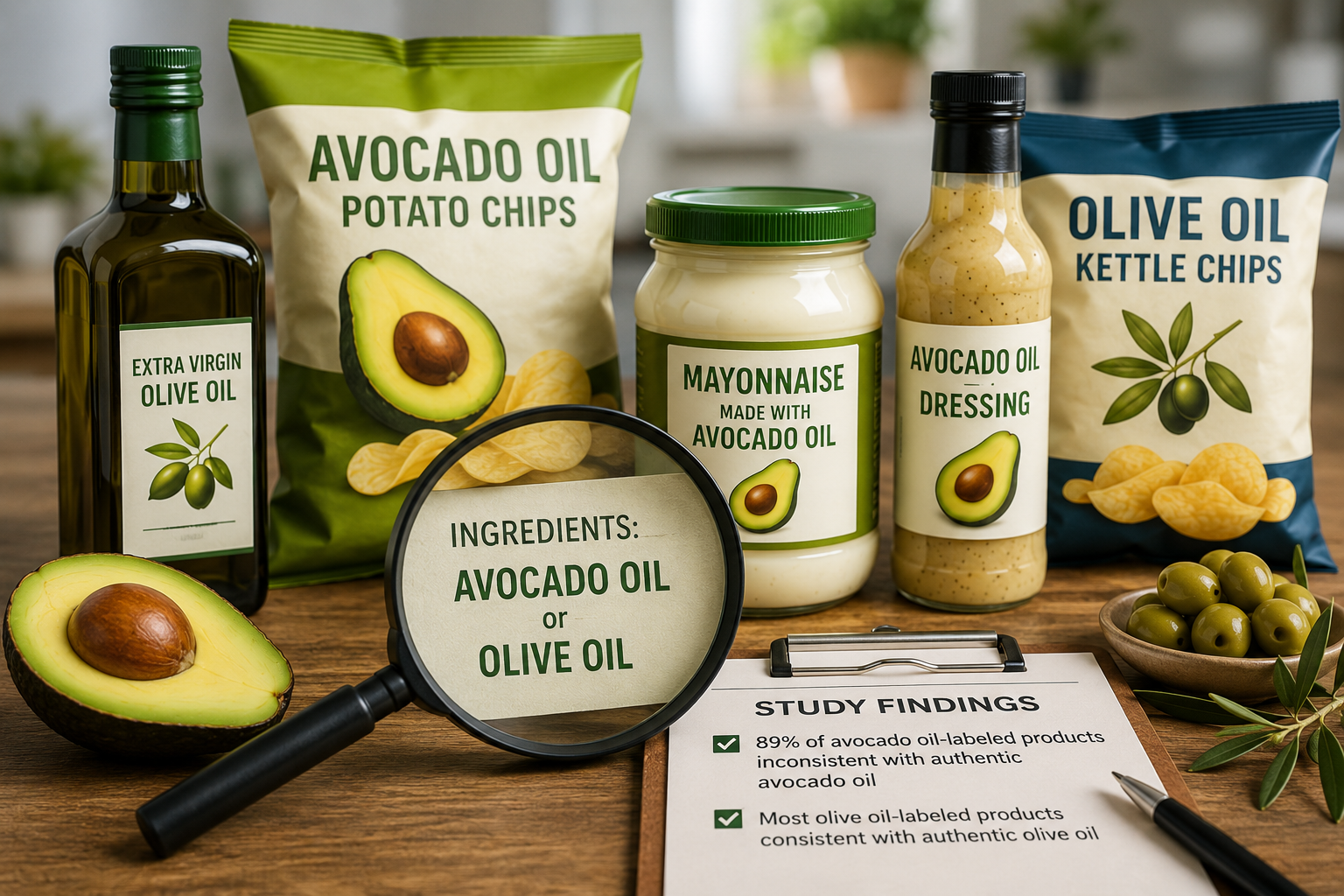
Consumers are increasingly finding avocado oil and olive oil promoted on packages of chips, mayonnaise, salad dressings and other processed foods. But new research from the University of California, Davis suggests that many products claiming to contain avocado oil may not have an oil composition consistent with authentic avocado oil.
The study, published in Applied Food Research, was conducted by Natalie Lopez-Alvarez, Xueqi Li, Benjamin Vizgordiski and Selina C. Wang of UC Davis. Researchers examined oils extracted from 74 commercial products labeled as containing avocado oil or olive oil. They compared fatty acids and sterols in the extracted oils with compositional standards established by Codex Alimentarius.
The biggest concern involved avocado oil. Overall, 89% of avocado oil-labeled products had compositional patterns inconsistent with authentic avocado oil. Results varied by product category: 93% of avocado oil-labeled chip samples were inconsistent, as were 100% of avocado oil salad dressings and 71% of avocado oil mayonnaise samples.
Olive oil performed considerably better. Researchers classified 90% of olive oil-labeled chips and 100% of the olive oil-labeled salad dressings and mayonnaise tested as consistent with authentic olive oil.
Researchers also conducted laboratory experiments to determine whether food processing itself could explain the unusual chemical profiles. Frying and emulsification produced relatively minor changes in important fatty acid and sterol markers. The researchers concluded that processing was unlikely to account for the large differences found in many commercial avocado oil products.
Which Brands Had Products With Inconsistent Results?
The accompanying brand information identifies the specific products and lots tested. Brands with at least one avocado oil-labeled sample that was not classified as compositionally consistent with authentic avocado oil included Boulder Canyon, Lesser Evil, Simply/Tostitos, Siete, Kettle Brand, Jackson’s, Sprouts, Sensible Portions, Bettergoods, Good Health, Primal Kitchen, Chosen Foods, Briannas, Sir Kensington’s and BetterBody Foods.
The researchers did not conclude that every product currently sold by these brands is noncompliant or adulterated. Some products showed lot-to-lot differences. For example, one lot of Lesser Evil’s avocado oil product was consistent while another was not, and the same pattern occurred with Simply/Tostitos. The study also tested only two lots of each product. By contrast, the avocado oil products tested from Siete, Kettle Brand, Jackson’s, Sprouts, Sensible Portions, Bettergoods and Good Health showed no compositional consistency in either tested lot. The avocado oil dressings tested from Sprouts, Primal Kitchen, Chosen Foods and Briannas likewise showed no consistent lots, nor did the tested avocado oil mayonnaise products from Chosen Foods, Primal Kitchen, Sir Kensington’s and BetterBody Foods.
Grove was a notable exception among the avocado oil mayonnaise products: both lots of its AvoYeah! Mayo Sauce and both lots of its Garlic Aioli were marked as compositionally consistent with authentic avocado oil.
The researchers emphasized several important limitations. Products were purchased during a specific period in 2025 and 2026, and formulations, suppliers and ingredient sourcing can change. Only two lots per product were tested, and regional sourcing differences were not evaluated. Consequently, the findings should be viewed as a snapshot of the particular products and lots analyzed—not a determination about everything a brand currently sells.
Still, the results raise significant questions about ingredient transparency. Consumers often pay a premium for foods promoted as containing avocado oil. The researchers concluded that ingredient-level oil claims may represent an underexamined area of potential economic adulteration and that price alone was not a reliable indicator of authenticity.
Original study: Authenticity of avocado and olive oils used as ingredients in commercially processed foods
Leave a Reply