
CASE NAME: Tiberia v. Lemme Inc.
CASE NO.: 2:26-cv-07581
JURISDICTION: United States District Court, Central District of California
FILED ON: July 13, 2026
CLASS DEFINITION: All individuals in the United States who purchased Lemme GLP-1 Daily capsules during the applicable class period, with a California subclass for in-state purchasers
SUMMARY:
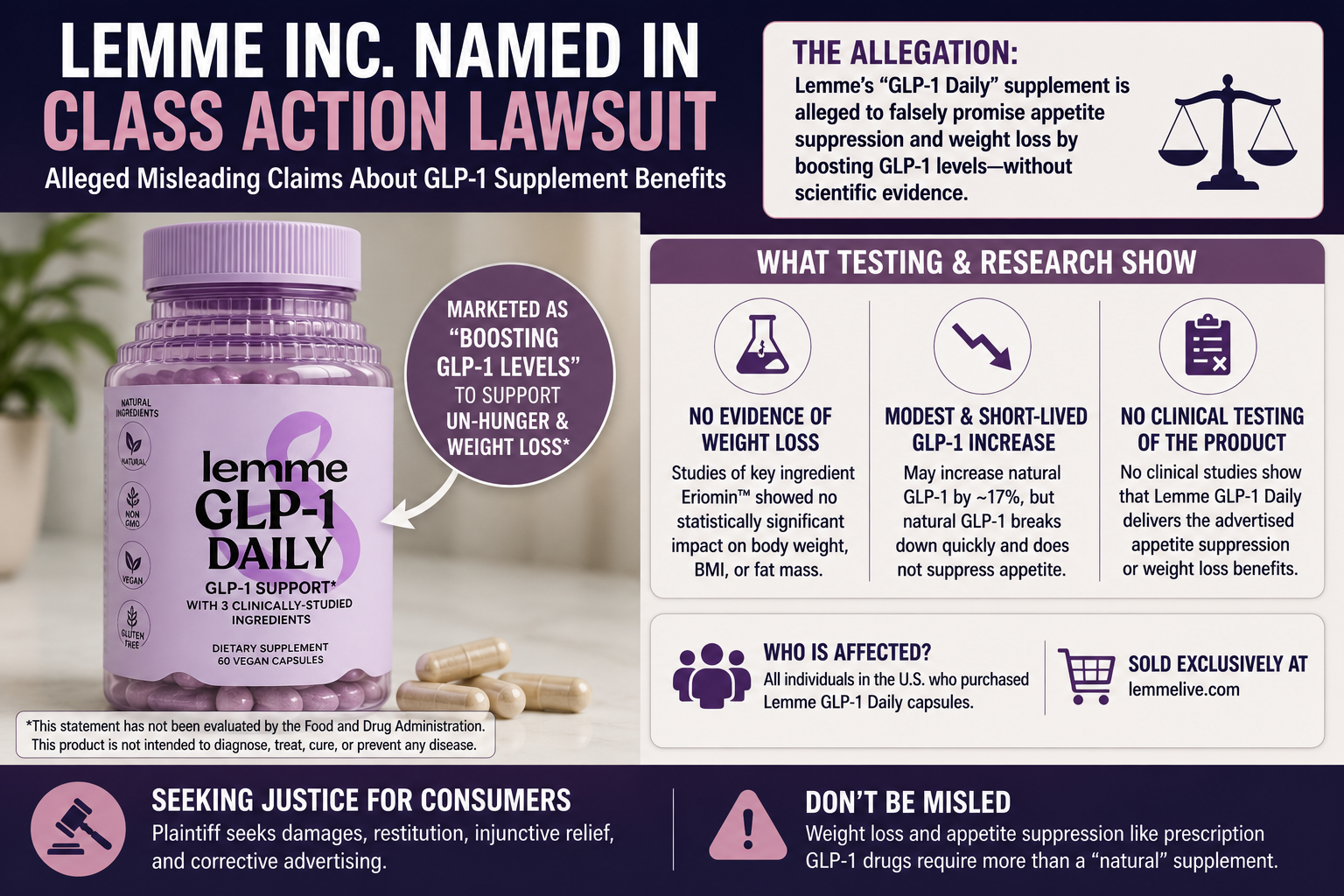
Lemme Inc. is accused of falsely marketing its “Lemme GLP-1 Daily” supplement as a natural alternative to prescription GLP-1 medications that can suppress appetite and promote weight loss. The lawsuit alleges that the company’s advertising misleads consumers into believing the product delivers effects comparable to pharmaceutical GLP-1 agonists, despite lacking clinical evidence to support such claims. Plaintiffs contend that consumers relied on these representations and paid a premium for a supplement that allegedly does not provide the promised benefits.
ALLEGATIONS:
The lawsuit alleges that Lemme launched and marketed its “GLP-1 Daily” capsules beginning in September 2024, promoting the product as a “natural” way to increase GLP-1 levels and achieve appetite control and weight loss. According to the complaint, the product was sold primarily through the company’s website and supported by a broad, uniform marketing campaign across social media and online platforms.
The plaintiff contends that Lemme’s advertising prominently emphasized that the supplement could “boost” GLP-1 levels and deliver “un-hunger” effects—implying reduced appetite and weight loss similar to prescription GLP-1 agonist drugs such as Ozempic or Wegovy. The complaint alleges that this messaging created the impression that the product was a comparable, safer alternative to these medications.
According to the complaint, these representations are misleading because there is no clinical evidence that modest increases in naturally occurring GLP-1—such as the approximately 17% increase allegedly associated with one ingredient—result in meaningful appetite suppression or weight loss. The lawsuit explains that natural GLP-1 has a very short half-life and breaks down quickly in the body, making it ineffective for sustained weight-loss effects without pharmaceutical modification.
The complaint further alleges that studies cited by the defendant do not support its marketing claims. For example, research on the ingredient “Eriomin” reportedly showed no statistically significant impact on body weight, body mass index, or fat composition, despite claims that it increases GLP-1 levels. Additionally, the lawsuit states that participants in these studies did not reduce caloric intake, undermining the claim that the supplement suppresses appetite.
The plaintiff also alleges that Lemme failed to conduct clinical testing on the product as a whole, instead relying on limited or flawed studies of individual ingredients. According to the complaint, there is no evidence that the combination of ingredients in the supplement produces the advertised effects, and such combinations may interact in ways that affect efficacy or safety.
The lawsuit further claims that Lemme’s marketing strategy exploited consumer awareness of the effectiveness of prescription GLP-1 drugs by drawing comparisons and emphasizing similar benefits, while downplaying the lack of equivalent scientific support. The complaint alleges that the company framed its product as a “natural solution” without adequately disclosing that it does not function like GLP-1 agonist medications.
According to the complaint, the plaintiff purchased the product after viewing advertisements that promised appetite suppression and weight-loss benefits. She alleges that she used the supplement as directed for several months but did not receive the advertised results. The lawsuit claims that she would not have purchased the product—or would have paid less—had she known the truth about its efficacy.
The complaint asserts that Lemme’s conduct resulted in economic harm to consumers, including paying a price premium for a product that allegedly does not perform as advertised. The lawsuit brings claims under California’s False Advertising Law, Consumer Legal Remedies Act, and Unfair Competition Law, among others, and seeks damages, restitution, injunctive relief, and corrective advertising.

Leave a Reply