CASE NAME: Karr v. Kao USA Inc.
CASE NO.: 26-cv-5992
JURISDICTION: United States District Court, Southern District of New York
FILED ON: July 15, 2026
CLASS DEFINITION: All persons in New York who purchased Ban Unscented antiperspirant and deodorant products for personal use within the applicable class period
SUMMARY:
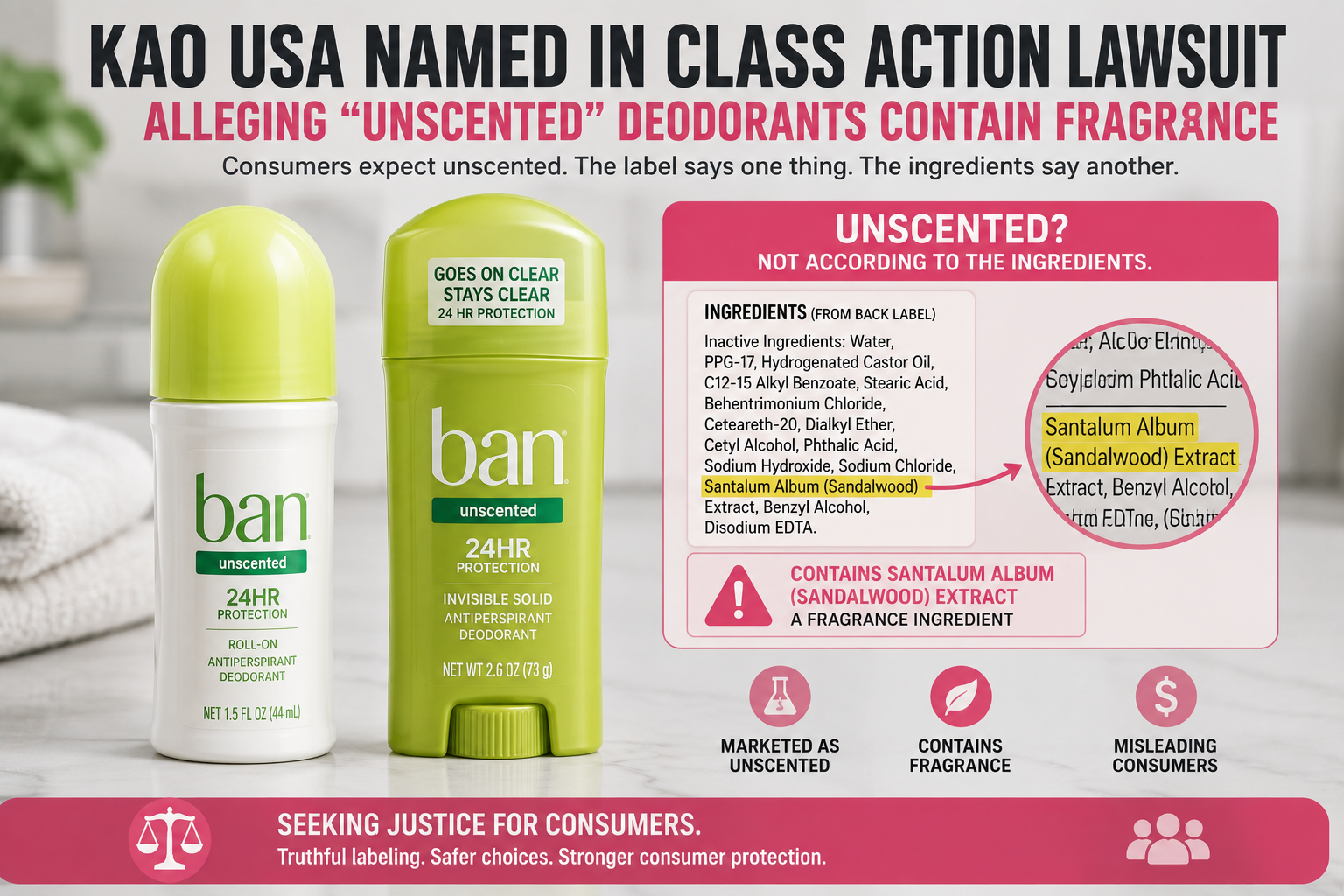
Kao USA Inc. is accused of falsely marketing its Ban “Unscented” antiperspirant and deodorant products as free from fragrance ingredients despite allegedly containing a known fragrance component. The lawsuit claims that the “unscented” labeling misleads consumers seeking fragrance-free products, particularly those concerned about skin sensitivity or irritation. The plaintiff alleges that consumers relied on these representations and paid a premium for products they believed contained no fragrance, when in fact they allegedly did.
ALLEGATIONS:
The lawsuit alleges that Kao USA engaged in deceptive labeling and marketing practices by prominently advertising its Ban products as “unscented.” According to the complaint, this representation appears clearly on the front of the packaging and conveys to reasonable consumers that the products do not contain fragrance ingredients.
However, the plaintiff contends that this claim is false and misleading because the products allegedly contain Santalum album (sandalwood) extract, which is identified in the ingredient list and is commonly used as a fragrance ingredient in personal care products. As shown in the ingredient disclosures referenced in the complaint (including the images on page 6), this ingredient is present despite the “unscented” claim on the front label.
According to the complaint, sandalwood extract is a fragrant oil widely used in cosmetics and perfumes, and its inclusion contradicts the expectation that an “unscented” product contains no fragrance components. The lawsuit alleges that the presence of this ingredient renders the “unscented” representation false.
The plaintiff further alleges that consumers are increasingly seeking out unscented personal care products due to concerns about skin irritation, allergies, and sensitivity to fragrances. The complaint states that fragrance ingredients are commonly associated with adverse reactions such as redness, itching, and rashes, making fragrance-free claims particularly important to consumers.
The lawsuit contends that Kao USA capitalized on this consumer demand by labeling its products as “unscented,” thereby appealing to individuals seeking gentler, minimalist formulations. According to the complaint, this labeling was a material factor in consumers’ purchasing decisions.
The plaintiff also alleges that consumers are unlikely to discover the alleged misrepresentation by reviewing the ingredient list. The complaint argues that reasonable consumers rely primarily on front-of-package claims and should not be expected to scrutinize small-print ingredient disclosures to verify those claims. Additionally, there is no qualifying language or disclaimer on the front label indicating the presence of fragrance ingredients.
According to the complaint, the labeling creates a uniform and misleading impression across all units of the product, meaning that all purchasers were exposed to the same alleged deception. The lawsuit claims that consumers were misled into believing the products were fragrance-free and would not have purchased them—or would have paid less—had they known the truth.
The plaintiff alleges that this conduct resulted in economic harm, including paying a price premium for products that did not meet advertised expectations. The complaint further asserts that the products do not possess the characteristics or qualities promised by the “unscented” claim.
The lawsuit brings claims under New York General Business Law §§ 349 and 350, alleging deceptive business practices and false advertising. The plaintiff seeks damages, restitution, injunctive relief, and other remedies to address the alleged misconduct and prevent future deceptive labeling.
Leave a Reply