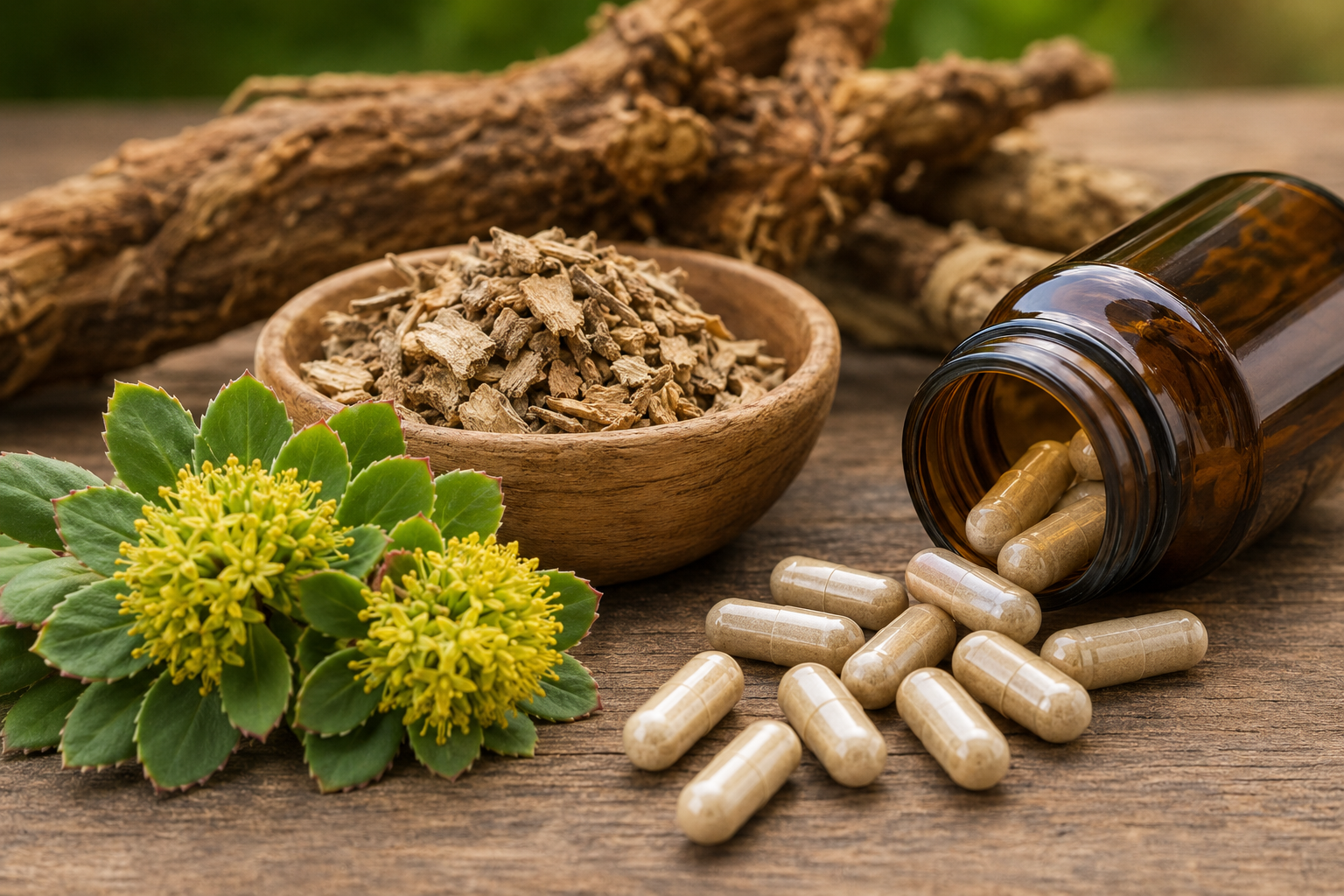
A new study published in PLOS One by researchers Steffen Porwollik and Mahtab Jafari from the University of California, Irvine, raises concerns about the quality, consistency, and safety of Rhodiola rosea supplements sold in the United States. Rhodiola rosea, often called “golden root” or “Arctic root,” is a popular herbal supplement promoted for stress relief, exercise performance, mental health support, and anti-aging benefits. The market for Rhodiola supplements in the U.S. has grown rapidly in recent years, with annual sales growth estimated at more than 10%.
The researchers analyzed 10 commercially available Rhodiola products purchased through Amazon in 2024. The products included seven capsule supplements and three tinctures. The study examined whether these supplements contained the levels of key active compounds claimed on their labels and whether they were contaminated with heavy metals or pesticide residues.
The two main biomarker compounds measured in the study were rosavins and salidroside, which are commonly used to assess Rhodiola quality. Scientists and manufacturers often rely on these compounds to standardize extracts because they are believed to contribute to many of the herb’s health effects.
The findings revealed major inconsistencies between products. Rosavins concentrations ranged from as low as 0.01% to as high as 3.08%, while salidroside levels ranged from 0.07% to 2.91%. Several supplements failed to meet the amounts advertised on their labels. One capsule product labeled as containing 1% rosavins actually contained nearly five times less. Another product marketed as containing 3% rosavins measured only about half of the stated amount.
Researchers also identified a product that appeared to contain an undisclosed addition of synthetic salidroside or possibly a mixture of different Rhodiola species. In this case, the supplement had extremely low rosavins levels but unusually high salidroside concentrations. According to the study, this imbalance may indicate adulteration or manufacturing manipulation.
The tincture products generally had lower concentrations of both biomarkers than the capsule products. However, they also appeared cleaner in terms of contamination. None of the tinctures contained detectable heavy metals or pesticide residues.
The capsule supplements showed a different picture. All seven capsule products contained trace amounts of arsenic, cobalt, and lead. Some also contained cadmium and mercury. Two products stood out for particularly high levels of arsenic and cobalt. One capsule contained arsenic concentrations more than six times higher than the median value detected among the tested products, while cobalt levels were more than fourteen times higher.
Although the researchers noted that the detected amounts do not automatically mean the supplements are dangerous, they emphasized that more testing is needed to determine whether some products exceed long-term safety limits established by the U.S. Department of Health and Human Services. The study did not perform arsenic speciation testing, which is necessary to determine whether the detected arsenic was in a more toxic inorganic form.
The good news for consumers is that none of the products tested positive for the 70 pesticides included in the U.S. Pharmacopeia screening panel. However, the researchers noted that some modern pesticides of concern, including glyphosate and neonicotinoids, were not part of the testing process.
The authors stressed that herbal supplements in the United States are not regulated as strictly as pharmaceutical drugs before they reach the market. While manufacturers are expected to follow FDA manufacturing guidelines, many products are not independently verified before sale. Previous research on herbal supplements has also found widespread problems with adulteration, inaccurate labeling, and contamination.
Despite the quality concerns, the researchers noted that the biological benefits of Rhodiola may not depend solely on rosavins or salidroside levels. Earlier studies by the same research group showed that extracts with lower biomarker concentrations still produced beneficial effects in animal models, suggesting that other plant compounds may also contribute to Rhodiola’s adaptogenic properties.
Overall, the study highlights the need for stronger quality control, better manufacturing transparency, and more frequent independent testing of herbal supplements sold in the U.S. The researchers recommend that consumers look for products with third-party verification and clear sourcing information when purchasing Rhodiola supplements.
Original Source: https://doi.org/10.1371/journal.pone.0341070
Leave a Reply