
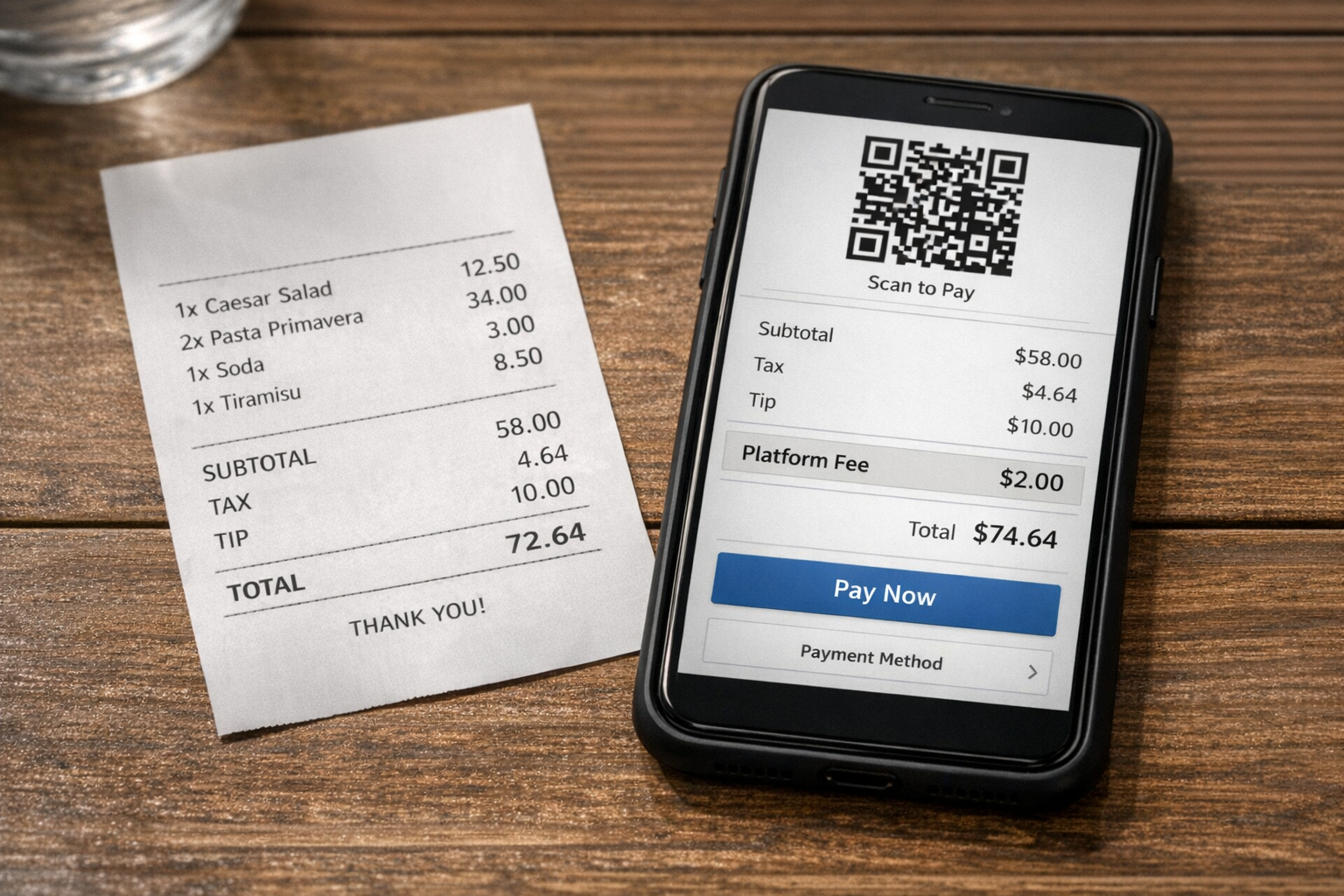
On January 20, 2026, plaintiffs Samuel Hoke and Laniesa Shafer filed a proposed class action in the United States District Court for the Northern District of Georgia against Sunday App, Inc., a restaurant payments technology company based in Atlanta, Georgia. The complaint (Case No. 1:26-cv-00333-TWT) alleges that Sunday assesses a mandatory “Sunday Platform Fee” on transactions completed through its QR-code payment platform and that the fee is hidden or inadequately disclosed until the end of the checkout process.
According to the complaint, Sunday provides QR-code–based payment tools that let consumers scan codes on receipts, checks, or payment screens to pay restaurant bills using their mobile phones. Plaintiffs allege consumers use Sunday expecting a faster checkout experience and that they do not expect an additional mandatory fee beyond the amounts shown on receipts and applicable taxes. The complaint states that Sunday does not clearly and prominently disclose, before consumers proceed through the payment flow, that an additional platform fee will be automatically added to the transaction total.
Plaintiffs claim the fee is added at the end of a multi-step payment flow—often only immediately before completion of the transaction—and that the placement and naming of the line item obscure its nature, leaving many consumers unaware the fee was assessed. The complaint alleges the fee is mandatory, varies with the subtotal in some instances, is not a government-imposed charge or gratuity to restaurant staff, and provides no additional value to consumers. The complaint characterizes this practice as digital “drip pricing” that exploits consumer inertia and prevents meaningful price comparison.
The complaint describes two individual consumer experiences. Plaintiff Hoke alleges that on or about December 12, 2025, he used Sunday to pay a restaurant bill in Los Angeles that totaled approximately $184.00 before taxes and fees; he alleges Sunday added a mandatory Sunday Platform Fee of $4.99 that was not clearly disclosed earlier in the payment flow. Plaintiff Shafer alleges that on or about December 6, 2025, she used Sunday in Chicago to pay an order totaling approximately $39.95 before taxes and fees; she alleges Sunday added a mandatory Sunday Platform Fee of $0.69 that was not clearly disclosed earlier in the payment flow. Both plaintiffs state they would have chosen another payment method had they known about the mandatory fee in advance.
Plaintiffs assert claims on behalf of nationwide and state subclasses. The complaint’s asserted classes are: a Nationwide Class of consumers who paid a “Sunday Platform Fee” when making a purchase through the Sunday platform during the applicable limitations period; a California Subclass of consumers residing in California who paid such a fee during the period; and an Illinois Subclass of consumers residing in Illinois who paid such a fee during the period.
The complaint asserts multiple legal claims including: (1) violation of the Illinois Consumer Fraud and Deceptive Business Practices Act (on behalf of Plaintiff Shafer and the Illinois Subclass); (2) violation of California’s Unfair Competition Law (Cal. Bus. & Prof. Code § 17200) (on behalf of Plaintiff Hoke and the California Subclass); (3) false and misleading advertising (Cal. Bus. & Prof. Code § 17500); (4) violation of California’s Consumers Legal Remedies Act (CLRA) (Cal. Civ. Code § 1750, et seq.); (5) violation of the Georgia Fair Business Practices Act (Ga. Code Ann. § 10-1-390, et seq.) on behalf of the Nationwide Class; (6) breach of contract on behalf of Plaintiffs and the Nationwide Class; and (7) unjust enrichment (alternative to breach of contract).
Jurisdiction is asserted under the Class Action Fairness Act (28 U.S.C. § 1332(d)), with Plaintiffs alleging more than $5,000,000 in controversy and that proposed classes number at least 100 members. The complaint requests class certification, an injunction requiring Sunday to disclose its pricing practices, monetary damages (including compensatory, treble, statutory, and punitive damages where applicable), restitution, disgorgement of wrongfully obtained fees, attorneys’ fees and costs, pre- and post-judgment interest, and other relief the Court deems just and proper. Plaintiffs also demand a jury trial on all claims so triable.
The complaint additionally references federal guidance and attention to so-called “junk fees,” citing the White House and the Federal Trade Commission in support of the view that covert, mandatory fees can be deceptive and harm consumers.
Court: United States District Court for the Northern District of Georgia
Filing date: January 20, 2026
Case number: 1:26-cv-00333-TWT
CLASS DEFINITION: “Nationwide Class: All consumers who, within the applicable statute of limitations preceding the filing of this action to the date of class certification paid a \”Sunday Platform Fee\” when making a purchase through the Sunday platform.
California Subclass: All consumers who, within the applicable statute of limitations preceding the filing of this action to the date of class certification, while residing in California paid a \”Sunday Platform Fee\” when making a purchase through the Sunday platform.
Illinois Subclass: All consumers who, within the applicable statute of limitations preceding the filing of this action to the date of class certification, while residing in Illinois paid a \”Sunday Platform Fee\” when making a purchase through the Sunday platform.”




Leave a Reply